Creativity
The Rehabilitation of the Awareness of Eternal Life

— John Mappin for If Magazine.
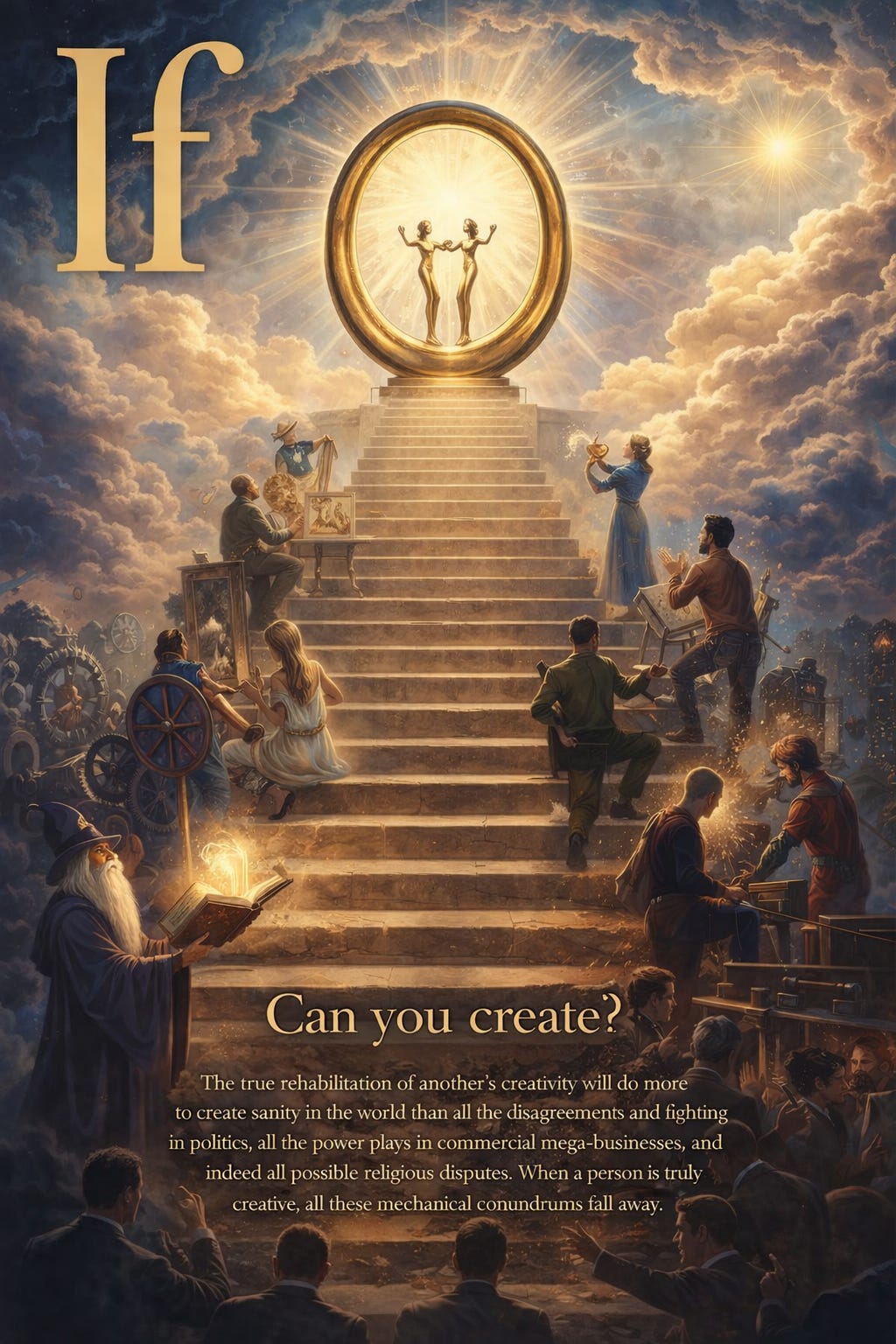
There is a quiet heresy in our age: the idea that creativity belongs only to artists, celebrities, to galleries, to the privileged elite few who can afford time, training, or permission. It is wrong.
Creativity is not a profession.
It is a condition of life.
When creativity is extinguished, something eternal is wounded. When it is restored, life itself is rehabilitated.
This is an invitation. Not to admire an object, but to remember a responsibility and the long lost action of a true power.
There is one question that matters in eternity perhaps more than any other, and it is rarely asked plainly, it is:
Can you create?
Not what you do. Not what you own. Not who you know.
Can you create?
This question is not a test. It is a door.
The Question That Opens the Door
When this question is answered honestly, everything else follows. If the answer is yes, life expands. If the answer has been buried, delayed, or silenced, life is in a contracting state but the door has been opened to reverse that.
The most important work of friendship begins here.
Friendship Is an Action, Not a State
Friendship is often mistaken for a static condition — a label, a sentiment, a shared history. It is none of these.
Friendship is an action.
A true friend does not merely accompany life as it is lived. A true friend intervenes at the precise point where creativity has been suppressed, diminished, or forgotten.
The most powerful act of friendship is the deliberate unsuppression of another human being’s creative force — or the deliberate assistance that allows that creativity to reach new and higher ground.
This is the dignity of friendship.
Not rescue. Not control. Not validation.
But the courage to recognise what another can create, and to refuse to let that capacity remain buried.
This is not sentimentality. It is mechanics.
When one person recognises the creative capacity of another, something objective occurs. Permission returns. Fear loosens its grip. The question Can you create? is answered in action, not words.
Civilisations are built when creativity is encouraged; they decay when it is suppressed. The same is true of individuals. The role of the true friend is to stand beside another and say, sometimes without words: Create again. You are needed.
Creativity Is Not Art Alone
Art is only one dialect of creativity — and for many people, not even the primary one.
Creativity appears wherever human beings bring something new, benign, and purposeful into the world — regardless of whether it is beautiful, applauded, or noticed.
For some, creativity is aesthetic. For others, it is entirely mechanical, pragmatic, structural, or operational. There are people whose deepest creative strength lies not in form or beauty, but in function, systems, precision, or reliability.
Some create solutions.
Some create stability.
Some create order where chaos once lived.
Some create processes that allow others to flourish.
Some create simply because they enjoy making something work.
None of this is secondary.
Creativity is not defined by elegance, but by alignment — that exact moment when a person is doing what they most naturally exist to do.
The teacher who finds a new way to reach a forgotten child.
The engineer who solves a problem everyone else accepted as inevitable.
The farmer who restores life to exhausted land.
The builder who makes something that lasts.
The entrepreneur who builds honestly and employs generously.
The parent who invents safety, joy, and confidence where fear once lived.
The friend who refuses to let another abandon their calling.
Creativity is any act that aligns talent with truth.
The Sculpture: Friendship Into Eternity
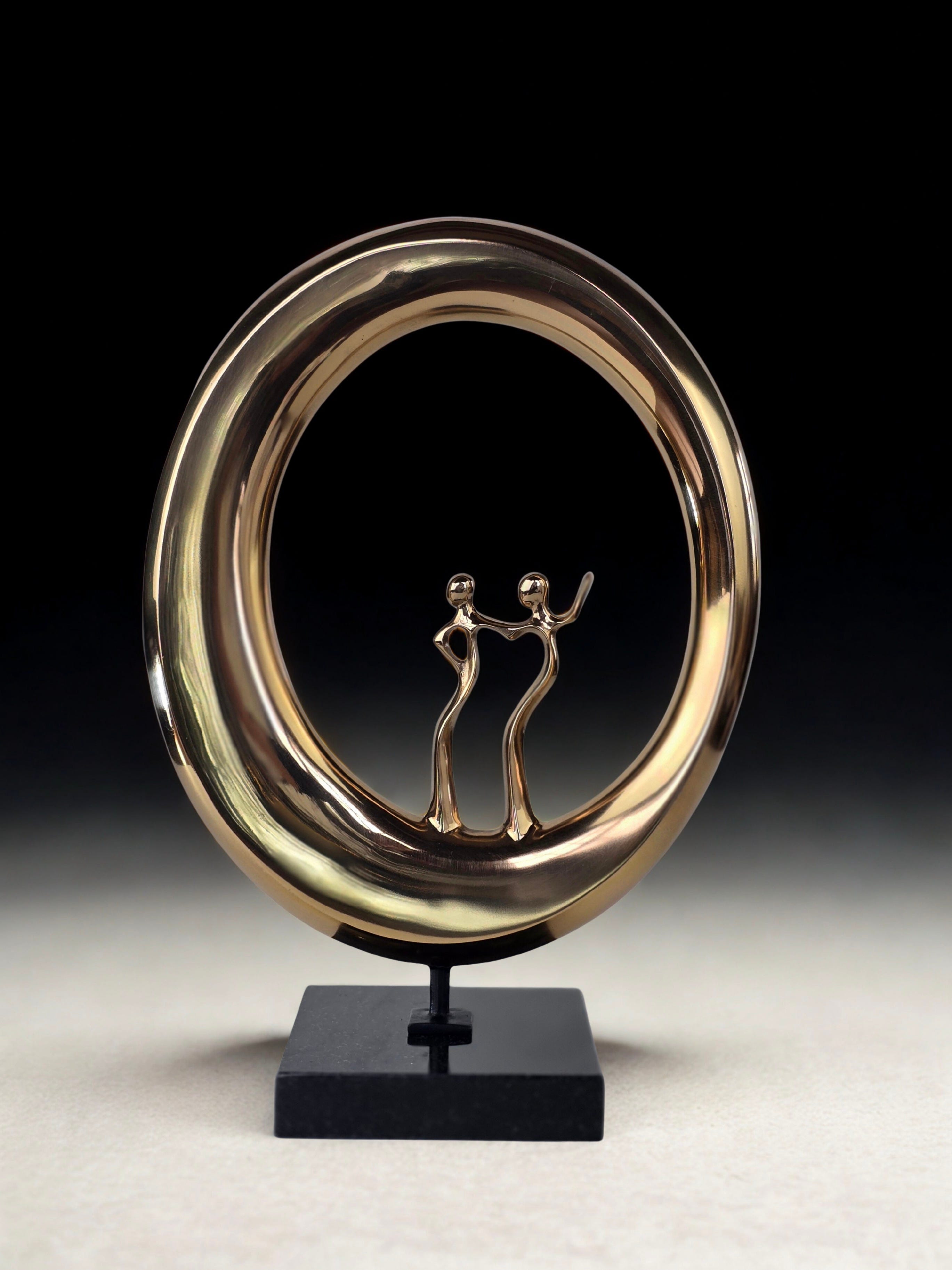
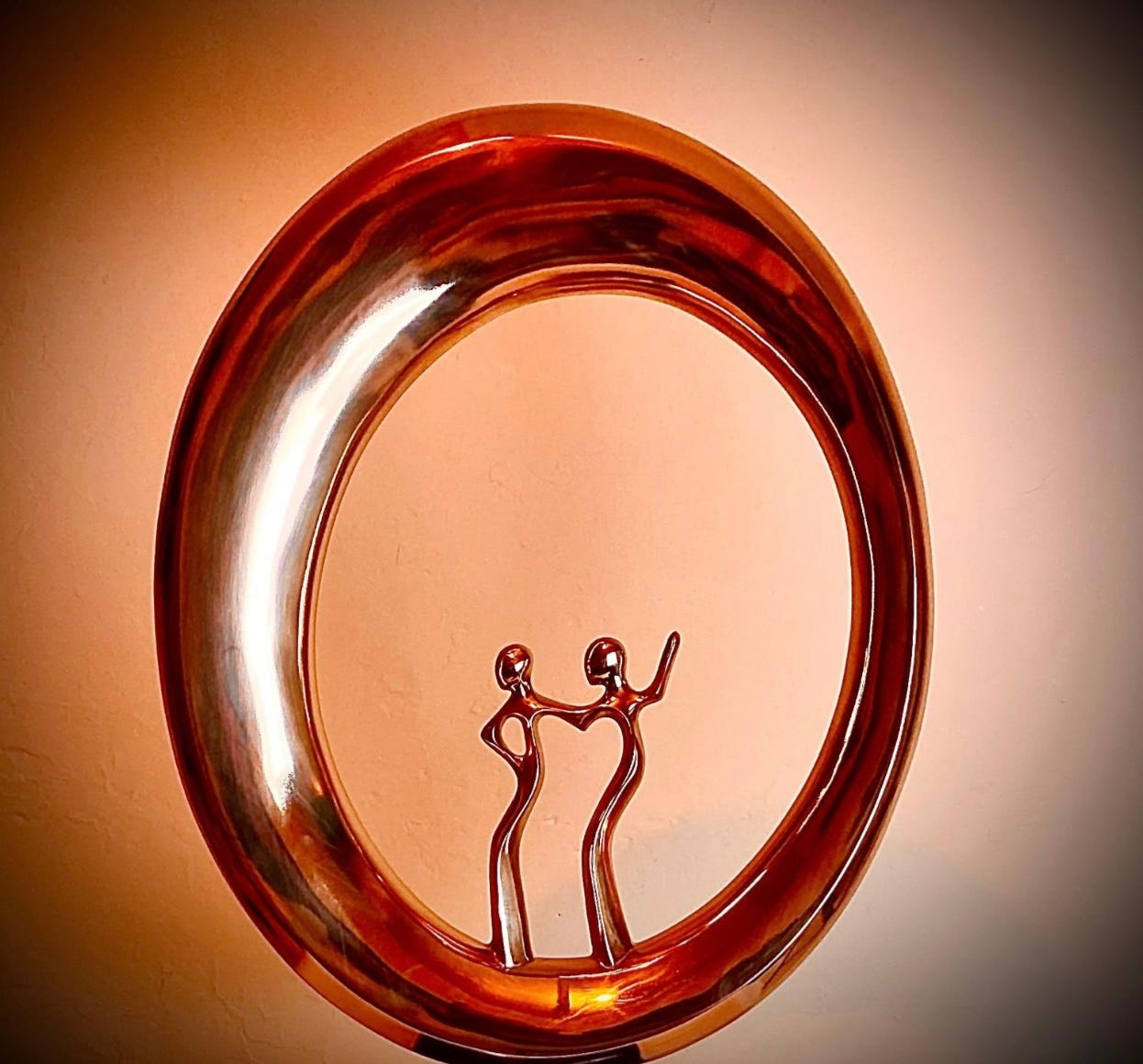
The sculpture before you is not decorative. It is declarative.
Two figures stand together, enclosed by a continuous, unbroken form. The circle is not a frame; it is time itself. There is no beginning visible, and no end. This is intentional.
The figures do not dominate one another. They are equal. Upright. Alert. Each presence strengthens the other.
This is friendship into eternity.
The sculpture exists in multiple scales, because creativity itself is scalable. What begins as a small encouragement can become a life’s work. What begins privately can resonate across generations.
Creativity as the Rehabilitation of a Human beings awareness of their eternal nature.
To rehabilitate creativity is not to save someone. It is to restore who the truly are and always have been.
Every human being exists with a specific creative purpose. When that purpose is suppressed, frustration follows. When frustration accumulates, it expresses itself as conflict — political, corporate, ideological, and religious.
The true rehabilitation of another person’s creativity will do more to restore sanity to the world than all other activity.
When a person is genuinely creating — aligned with what they exist to do — the mechanical conundrums of identity, status, grievance, and power fall away. They are too occupied with building, solving, restoring, or making something real to require an enemy.
To rehabilitate creativity is to restore access to sanity itself.
This is why creativity feels eternal. It was there before fear. It will outlast fashion. It survives every attempt to minimise the soul.
A Call, Not a Conclusion
The question remains with you long after this page is closed:
Can you create?
And just as importantly:
Who do you see clearly enough to ask it of them?
This is not an explanation. It is an opportunity.
Ask yourself:
Where have you or others accepted diminishment when you were meant to create?
The future does not belong to the loud, the cruel, or the brutal. It belongs to those who quietly re‑ignite creativity in others.
That is how lives are saved without drama.
That is how friendships become eternal.
That is how your creativity rehabilitates life itself.
It is the path to the true golden age.
John Mappin
IF Magazine
Thank you. Enjoyed that.
Beautiful.